
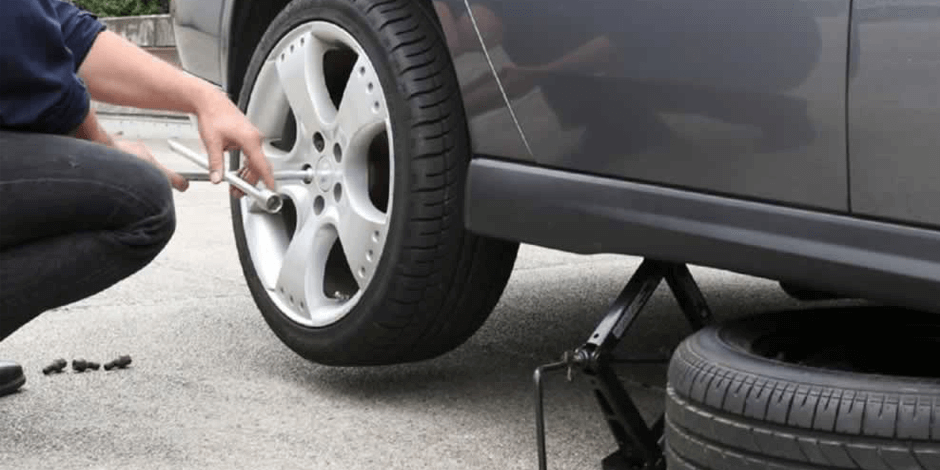
Short answer: to change a tire, pull the car over to a flat, safe place, switch on the hazard lights, place the warning triangle and apply the handbrake. Loosen the wheel nuts while the car is still on the ground, place the jack at the point shown in the owner's manual and lift the car, remove the nuts and the flat tire, fit the spare tire and tighten the nuts in a criss-cross order. After lowering the car, give the nuts a final tightening and check the spare's air pressure. An unexpected flat tire on the road can happen to anyone; if a tire goes flat on a car rented from SAW Rent A Car, call our customer service before you start.
The jack point, the wheel nut torque and the spare tire's speed limit differ on every model; the car's owner's manual is what counts. Article numbers on renting refer to the SAW Rent A Car rental conditions.
When you notice a flat tire, do not brake suddenly. Hold the steering wheel firmly, ease off the accelerator and slowly pull over to the side of the road. Before you start changing the tire, park the car on flat, firm ground away from traffic. On a bend, on a slope or on soft earth the jack can slip; driving slowly for a few hundred metres to find a suitable spot is safer than waiting with a flat tire.
Changing a tire in a car park is safer than on the road, but watch the slope of the ground. In covered car parks, choose a flat concrete area for the jack and keep away from ramps. If there is not enough room to work around the car, move it slowly to an empty space; take care when opening the doors so you do not hit other cars.
Before you start changing the tire, you need to have the necessary equipment ready. On most cars it sits under the boot floor, next to the spare tire:
| Equipment | What it is for | Note |
|---|---|---|
| Spare tire | Temporarily replaces the flat tire | On a space-saver spare the speed limit is written on the tire |
| Jack | Lifts the car until the tire is off the ground | Only placed at the jack point in the manual |
| Wheel wrench (lug wrench) | Loosens and tightens the wheel nuts | Found in the tool kit |
| Warning sign (triangle) | Warns approaching drivers | Used together with the hazard lights |
| Gloves | Protect your hands from dirt and hot rims | If you have none, use a cloth |
| Torch | Makes working at night possible | A phone torch also works |
After you finish changing the tire, check the spare's air pressure at the first fuel station. Checking the tightness of the nuts again after a few kilometres prevents loosening as the wheel settles.
On many cars the spare is a temporary tire that is narrower and lighter than a normal one. Do not exceed the speed and usage limit written on that tire and in the car's manual; continuing a long journey on a space-saver spare weakens braking and grip. The spare is only meant to get you to the nearest tire shop or a safe place.
Some newer models have a tire repair kit instead of a spare. The kit temporarily seals and inflates the tire in small nail punctures; it does not work for sidewall cuts or rim damage. The kit's instructions are usually on the box. If the sidewall is torn or the rim is bent, do not force the change; ask for help.
When a tire goes flat on a rental car, first make yourself safe, then call our customer service (WhatsApp/phone 0850 304 94 30). Share your location, the number plate and the state of the tire; we will decide together whether you continue on the spare or wait for help. Talk to us before going to a tire shop or buying a new tire.
Checking that the spare, the jack and the wheel wrench are in place when you collect the car makes this moment easier. For the other handover checks see our 10 tips you should know before renting a car, and for the airport process see our guide to vehicle delivery and return at the airport.
Choosing tires in winter and the winter tire requirement are a separate topic; for dates and rules see our winter car rental tips. In Istanbul you can book your car through Sabiha Gokcen Airport or Istanbul Airport.
Wheel nuts are tightened in a criss-cross, or star, order: after tightening one nut, move to the one opposite. Seat them by hand first, and after lowering the car do the final tightening in the same criss-cross order.
The jack goes at the jack point shown in the owner's manual, usually marked by a notch under the door sill. A jack resting on plastic parts, the bumper or the suspension damages the car and can slip.
Yes. While the car is on the ground the wheel does not turn, so loosening the nuts is easy. Only loosen them; remove them completely after the car has been lifted with the jack.
On space-saver spares, the speed and usage limit is written on the tire and in the car's manual. The spare is a temporary solution; use it only to reach the nearest tire shop or a safe place.
It is risky because traffic passes very close to the hard shoulder. If possible, drive slowly to the next exit or rest area; if you cannot, switch on the hazard lights, place the warning triangle and keep the passengers behind the barrier.
Under article 4.9 of the rental conditions, tire and rim damage is the renter's responsibility. Extra cover options are described in article 6.2. Call our customer service (WhatsApp/phone 0850 304 94 30) before going to a tire shop.
If there is a tire repair kit instead of a spare, you can temporarily seal and inflate the tire in small punctures. The kit does not help with a sidewall cut or rim damage; do not move the car and ask for help.